Abstract
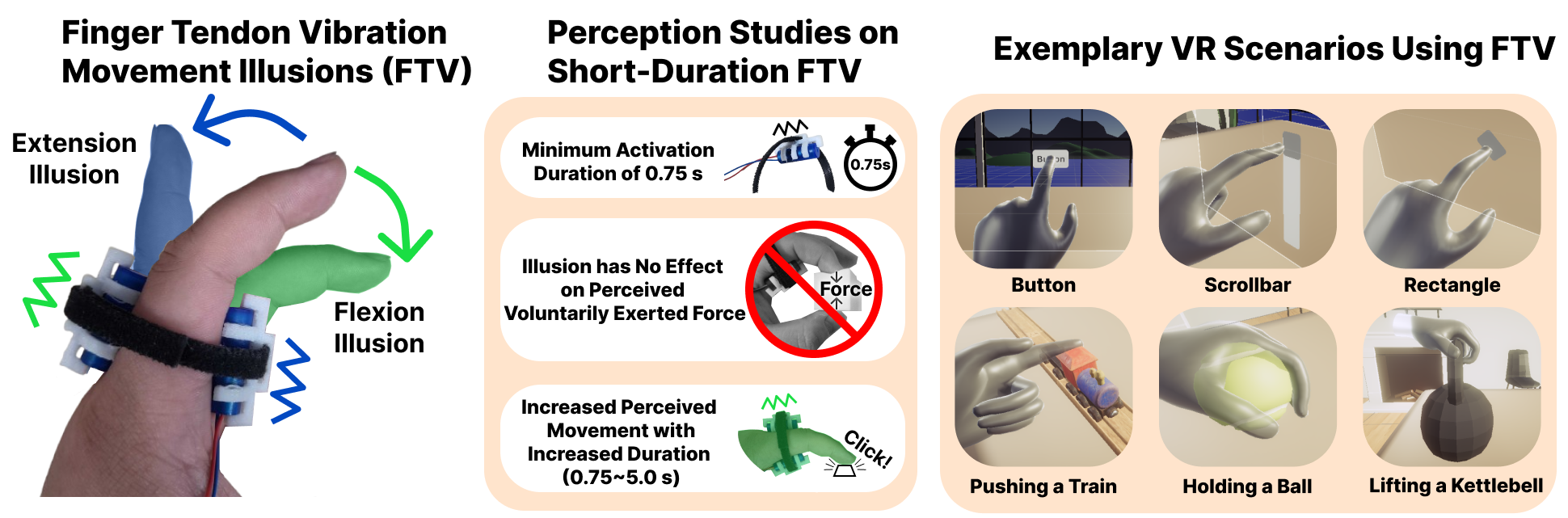
The absence of physical information during hand-object interaction in a virtual environment diminishes realism and immersion. Kinesthetic haptic feedback has proven effective in delivering realistic object-derived haptic cues, enhancing the overall virtual reality (VR) experience. Here, we propose kinesthetic illusion through a novel application of finger tendon vibration (FTV), which creates an illusory sensation of finger movement. To effectively apply FTV for virtual object interactions, we first examine the effects of short-duration FTV (<5s) through 3 perception studies. Based on study results, we design 6 exemplary VR scenarios, representing the overall design space of VR object interactions, and 4 different haptic rendering strategies for FTV. We evaluated these rendering methods on each VR scenario and derived a design guideline for FTV application. We then compared FTV with no vibration and simple vibration, observing that FTV enhances VR experience by providing realistic resistance on the finger, greatly improving body ownership.
Finger Tendon Vibration Perception Studies
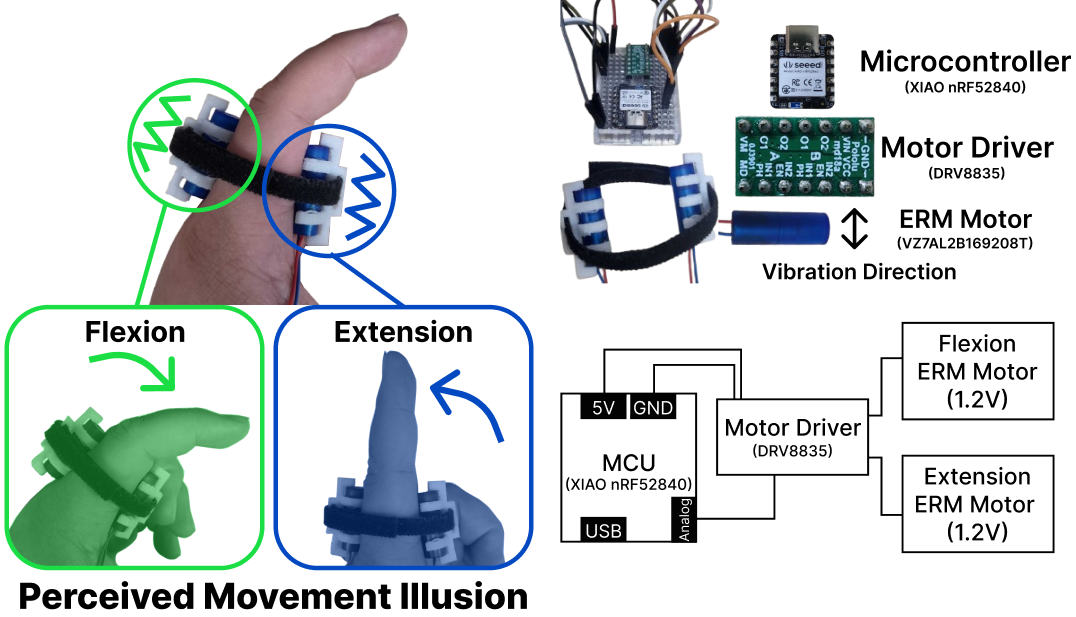
To elicit finger tendon vibration illusions, we applied vibration to the palmar and dorsal side of the proximal phalanx on the index finger. This created a feeling of finger flexion and extension respectively.
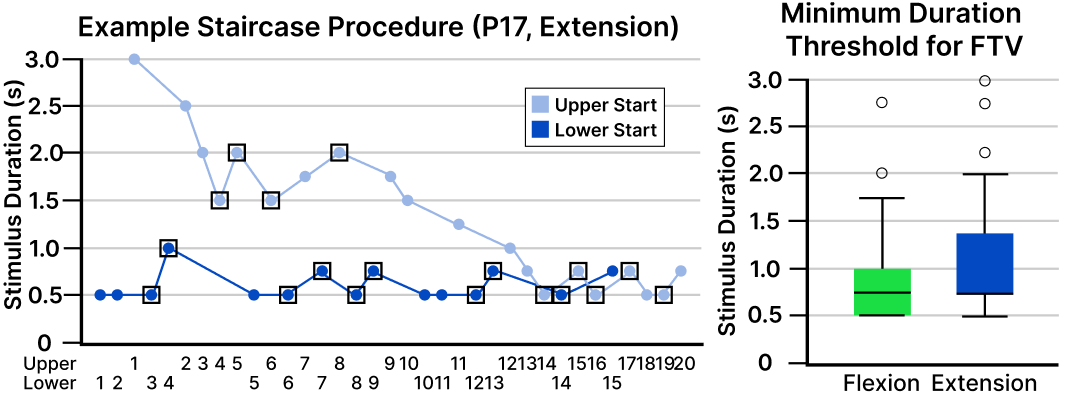
We first explored the minimum vibration duration threshold for creating the illusion. We conducted a double random staircase experiment, which resulted in a median end time of 0.75s.
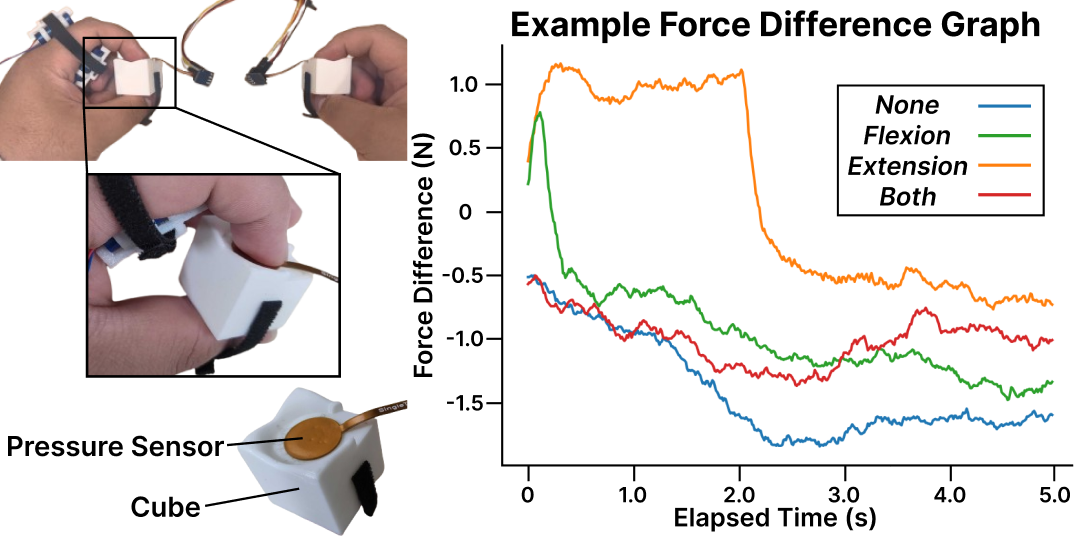
We next examined whether finger tendon vibration affects perceived voluntarily exerted force. Participants exerted a target force on their left finger and tried to match the force with their right finger. By applying vibration on the left finger, we measured the effect FTV has on exerted force. However, there were no significant differences for different vibration location and conditions.
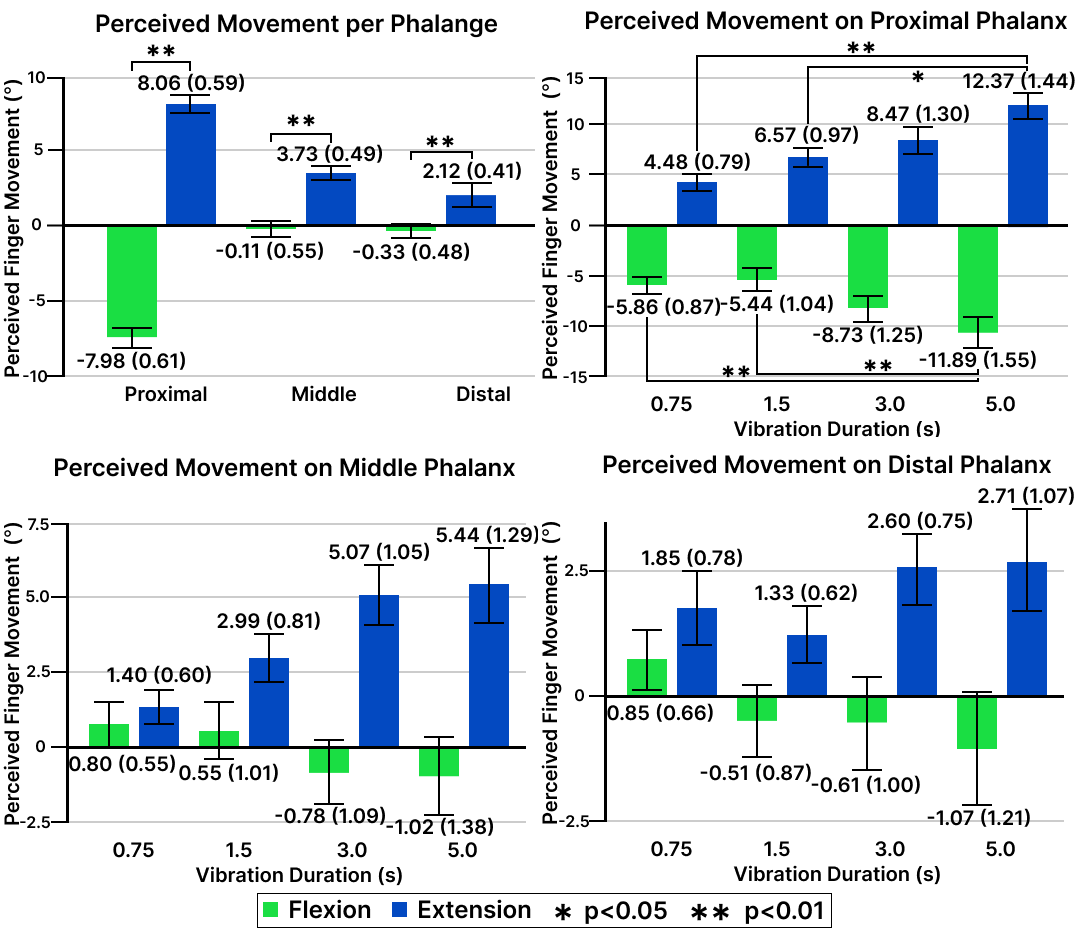
We lastly measured finger tendon vibration's effect on involuntary movement. We motion captured participants' fingers and asked them to recreate the illusion they felt from FTV. We found that short-duration FTV has a significant effect on involuntary movement, where the extent of movement increased as vibration duration increased.
Applying Finger Tendon Vibration to VR
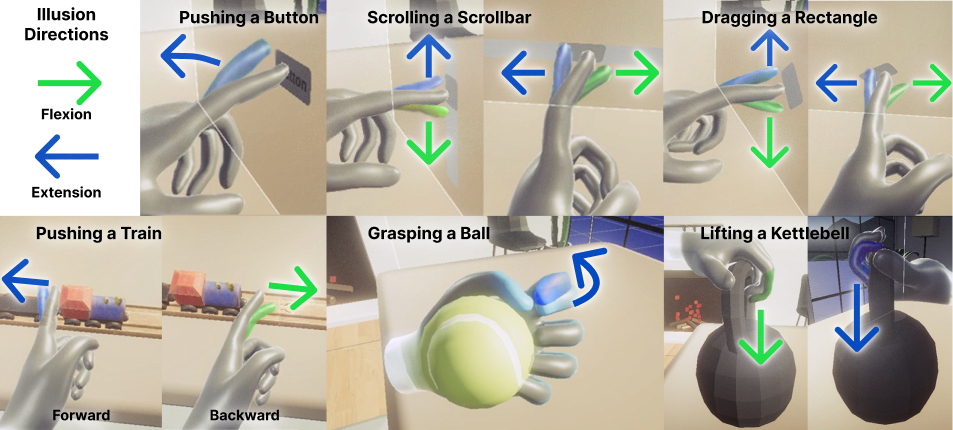
Based on the results of the perception studies, we formulated 6 VR scenarios where VR UI or objects applied a reactionary force on user fingers causing involuntary movement.
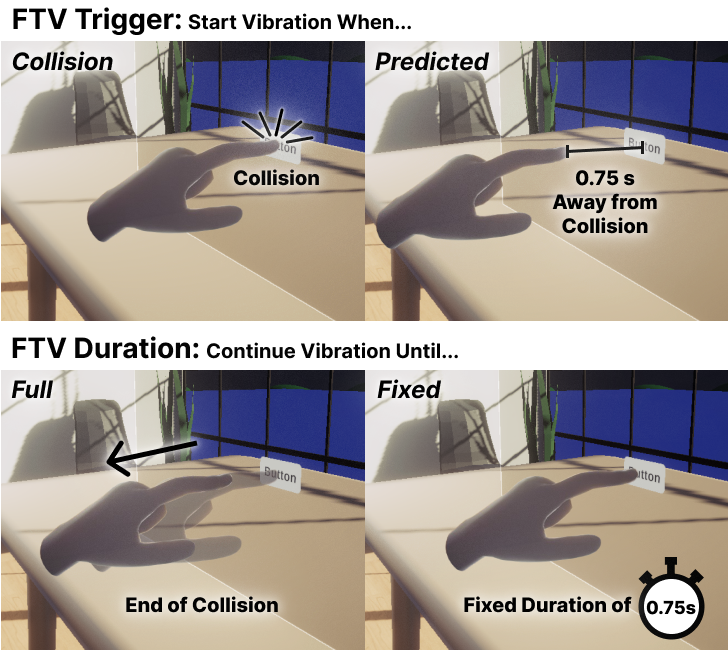
Likewise, based on the results of the perception studies, we devised different haptic rendering methods for finger tendon vibration.
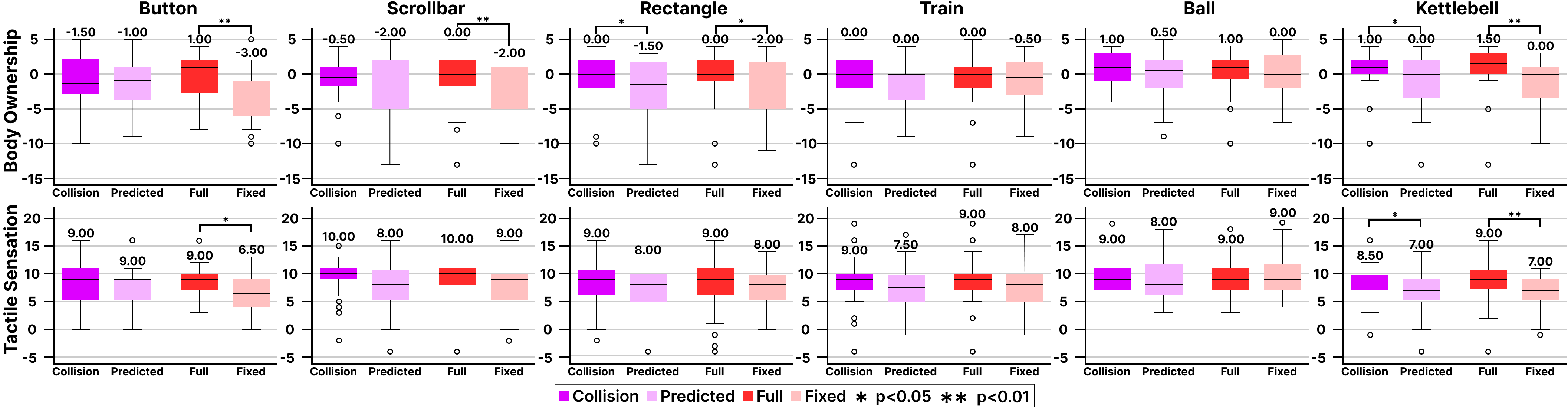
Our rendering method evaluation showed that despite the results from the perception studies, conventional collision-full rendering method performed best. Through this we conclude that proprioceptive cue delay is negligible as long as the interaction is long enough and designers using FTV cannot ignore tactile cues from the vibration itself.

We then compared FTV's overall VR experience by comparing it with a baseline of no vibration and simple vibration. FTV was the only method to improve body ownership. Participants also reported highly realistic feeling of physical resistance with a distinct force direction when using FTV.
BibTeX
@inproceedings{FingerTendonVibration2026,
  title={ Finger Tendon Vibration: Finger Movement Illusions for Immersive Virtual Object Interaction},
  author={Kun-Woo Song and Youngrae Kim and Sang Ho Yoon},
  booktitle={Proceedings of the 2026 CHI Conference on Human Factors in Computing Systems (CHI ’26)},
  year={2026},
  doi={https://doi.org/10.1145/3772318.3790557},
}